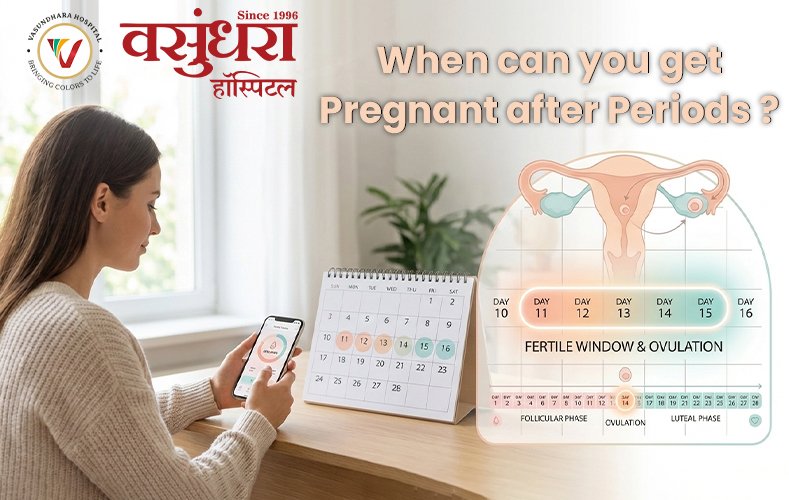
When can you get Pregnant after Periods? Expert Guide
Planning a pregnancy often begins with one important question: “When is the right time to conceive or pregnant ?” Rather than focusing on a fixed number of days after menstruation, successful conception depends on understanding ovulation and the body’s fertile phase.
How Pregnancy Timing Actually Works
Conception occurs only when a mature egg released from the ovary meets healthy sperm in the fallopian tube. This biological event is called fertilization and can happen only during a short and specific time in the menstrual cycle. This means:
Pregnancy does not occur randomly after periods
It happens during a biologically defined fertile phase
Understanding this phase is the key to improving natural conception chances.
What is the Fertile Window?
The fertile window refers to the few days in a menstrual cycle when pregnancy is most likely.
Healthy sperm cells can remain active within the female reproductive tract for several days
Once an egg is released from the ovary, it remains viable for only a very limited time
Pregnancy is possible only during the overlap of these two timelines
This narrow overlap is what doctors call the fertile window, and it plays a critical role in conception.
Best Time to Conceive After Periods (Cycle-Wise Explanation)
The most fertile days vary from woman to woman and depend largely on cycle length.
For a Regular 28-Day Menstrual Cycle
Ovulation commonly occurs around the middle of the cycle
The highest chances of conception usually fall between Day 10 and Day 16, counting from the first day of menstruation
Fertile Period Based on Cycle Length
Menstrual Cycle Length
Estimated Ovulation Phase
High-Fertility Days
26 Days
Early Mid-cycle
Day 8–13
28 Days
Mid-cycle
Day 10–16
30 Days
Slightly Later
Day 12–18
32 Days
Late Mid-cycle
Day 14–20
*These are approximate ranges. Individual hormonal patterns may differ.
Is Pregnancy Possible Immediately After Periods?
In most cases, the probability of pregnancy immediately after menstruation is low. However, conception can still occur if:
Ovulation happens earlier than expected
The menstrual cycle is shorter than average
Sperm remains active until ovulation
This is why relying only on calendar counting may not always be accurate.
How to Identify Ovulation More Precisely
Fertility experts recommend combining observation with medical guidance for better accuracy.
1. Changes in Cervical Fluid
During the fertile phase, vaginal discharge often becomes clear, slippery, and stretchy, indicating an ovulation-friendly environment.
2. Ovulation Predictor Kits
These kits identify hormonal changes that signal ovulation is approaching, helping couples time intercourse effectively.
3. Cycle Monitoring and Medical Evaluation
Tracking periods over several months and combining it with ultrasound or hormone testing gives the most reliable results.
When Should You Consult a Fertility Specialist?
Medical advice is recommended if:
Pregnancy has not occurred after 12 months of regular attempts (under 35 years)
After 6 months if age is above 35
Periods are irregular, extremely painful, or absent
Conditions like PCOS, endometriosis, or thyroid imbalance are present
Early consultation often prevents unnecessary delays and stress.